What’s in your headspace? What’s in your physical space?
You may have seen the image of the cluttered mind space indicating a mind full, and the mind only thinking of now – mindful. How do we move from the chatter in our minds to focusing on the now?
Lately, I’ve been thinking about how much power we have over our space, and the choices we have about the thoughts and ideas that enter our minds. I’ve also been thinking about the decisions we make about the objects we allow into our environments. I’ve wondered, how can we curate our physical and mental spaces?
What do we decide to live with? Discard? Highlight? Hide?
For me, it is all about intention. With intention, we create the boundaries and can disregard them. With intention, we can decide how long to ruminate over a story. With intention, we oversee the narratives in our mind. Changing the story can only happen if we are aware enough to recognize ourselves as thinking beings, and if we know that we are not our thoughts. Instead, we are the being having these thoughts.
As a witness to my own mind, I can step back and create space to widen the perspective. I can separate myself from clinging onto the many ideas in my mind and choose to focus on the ideas and feelings that match my intentions. I can do this so long as I have thought about what my intentions are, explored who I am, and uncovered what matters most to me.
Mindfulness can be about matching heart and intention with behavior. It can be flipping the switch from scarcity to abundance – exploring all that’s possible and all I am grateful for in this moment.
In the moment, we might notice the way the light interacts with objects around us, appreciate craftmanship, focus on our common humanity in the mundane, and in doing so we create beauty in our mind. The beauty existed the whole time. We just needed to make space to see it.
How can we make more space for mindfulness in everyday living? Since what we look for is what we see, deciding what we hope to see can be very helpful.
We can also find ways to remind ourselves of our intentions. We might display post it notes with affirmations, follow mindful leaders on social media, add an intention to our screen savers, and make space to pause so we respond instead of falling back on old communication patterns.
In a sense, we are finding ways to curate our physical space to impact our headspace. We can decide to add objects to our physical spaces that remind of us of our intentions, attach positive meaning to the things around us, or savor the positive meaning that already exists for us.
What phrases, images, objects, or surroundings bring you back to the present and remind you of your intentions?
One of us is the country mouse, and one of us is the city mouse. One of us can identify what’s growing in the fields, the number of hours left before darkness descends, and if it’s safe to approach an animal in the wild while one of us possesses other important life skills like parallel parking, navigating a grid of one-way streets, and procuring an Uber.
In this way, among many others, we’re a good team.
A year or two ago on a nature walk out behind my house, we spied a posse of turkeys up ahead in the laneway next to the woods. They weren’t very big, but they weren’t babies either, probably teens or young adults. No grown-ups in sight.
The city mouse said, “I’m scared.”
As the country mouse, it was my job to assure her that those baby turkeys were more afraid of us than we were of them, that they would go back into the tree line well before we got anywhere near them, and most of all, that it was safe for us to keep going.
“If you say so,” she said, and we kept moving forward—corn field on one side, woods on the other, turkeys straight ahead.
Uncharacteristically, those turkeys didn’t seek refuge in the trees as we got closer and closer still. Instead, they stood belligerently in place, daring us to walk by their jutting chests and menacing beaks. They definitely had to be teenagers.
She stopped, looked around, realized we were trapped. “What are we going to do?”
“We’re going to keep right on going,” I said more authoritatively than I felt, and then I switched sides with her so I was the one closest to the bird gang as we scooted by. With our heartrates elevated and the turkeys avoiding eye contact, we came through the gauntlet unscathed.
“Thank you for taking the turkey side,” she said.
A few months later, at a particularly difficult department meeting, she voiced an unpopular opinion, and I backed her up.
“Thank you for having my turkey side,” she said afterward.
“You’re welcome,” I said, and of course acknowledged how she’s done the same for me many times. “Perhaps you might want to soften that before hitting send,” she’ll say about some of my emails, helping me take off the rough edges, reminding me how I used to tell my kids to “use their in-town voices.”
This summer, another, even bigger posse of turkeys is collectively raising its young in the woods and fields surrounding my house. Just yesterday, the mothers and babies came into the yard, walked outside the labyrinth, dropped a fantastic feather.
After they left, I picked up the almost foot-long brown and black artifact, and because it was our turn to walk the streets near her house and because I knew she would love having it, I gave the turkey feather to my friend, the city mouse.
“Every time I look at this,” she said, obviously touched, “it will remind me how you always have my turkey side.” And I know she always has mine.
Who has your back? Who’s on your turkey side? Feel free to share in the comments.
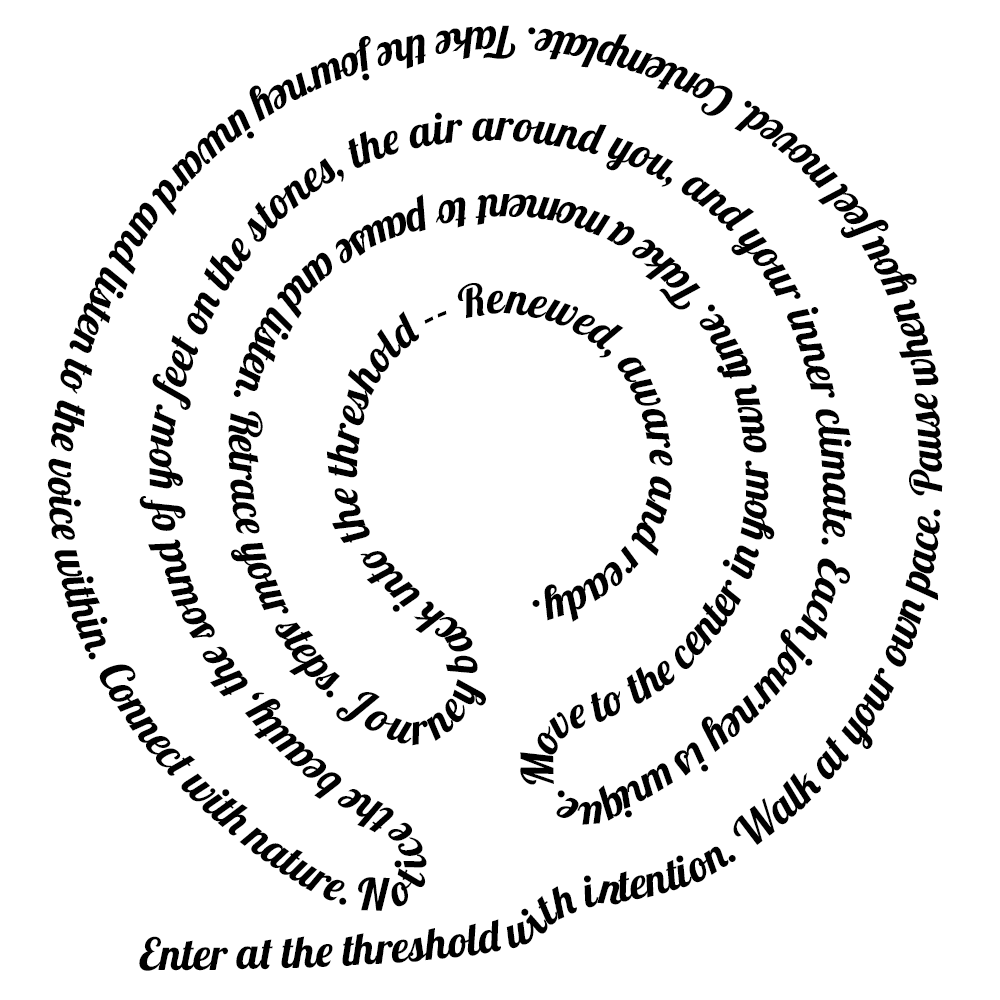
Check out the Locust Grove Labyrinth tab on our website. It is a beautiful stone labyrinth in a gorgeous natural setting. A place of peace and connection.
Where do you find peace and connection? Connect with us to find out more about the Locust Grove Labyrinth and/or for conversations about finding spaces that can restore and renew you.
A colleague recently shared an observation with us, a comment echoed by other coworkers as well: “It looks like Renee and Terry have hit the reset button.” We both agree those words are a compliment of the highest order as they perfectly capture our intentions while also providing evidence that our strategies and practices continue producing positive effects in many areas of our lives.
One tool that’s helped us progress on this reset path is Sharon Salzberg’s book, Real Happiness at Work: Meditations for Accomplishment, Achievement, and Peace (Workman, 2014). Salzberg organizes the book around her eight “Pillars of Happiness in the Workplace” and provides exercises, “stealth meditations,” examples, and Q&A for each pillar. Below are her definitions and some of the ways I’ve implemented each pillar to help me hit the reset button at work.
8 Pillars of Happiness in the Workplace
Balance, according to Salzberg, is “the ability to differentiate between who you are and what your job is.” How often are our jobs and our family obligations the first things that come to mind when asked about ourselves? Like most of us, I play a lot of roles at work, but realizing I am not those roles has helped me detach from over-identifying with my work and allowed me to embrace my deeper essence. Knowing that who I am at the core of my being remains steady and constant in the midst of whatever role I am performing allows me to experience better balance at work and a fuller sense of presence in all areas of my life.
Concentration, according to Salzberg, is “being able to focus without being swayed by distraction.” Here is where I truly try not to multi-task and to give my attention fully to one thing before moving on to the next. I don’t always succeed, but I keep practicing. Two strategies that have helped direct and maintain my concentration are keeping a prioritized to do list and using a timer for 10- to 60-minute work sessions.
Compassion, according to Salzberg, is “being aware of and sympathetic to the humanity of ourselves and others.” Lovingkindness meditations are great for developing recognition of our common humanity as is refraining from harsh judgments and gossip. Also, not speaking to myself in ways I wouldn’t speak to anyone else and keeping my medical and self-care appointments regardless of whatever unexpected obligation pops up at work were essential steps toward self-compassion and resetting my work habits.
Resilience, according to Salzberg, is “the ability to recover from defeat, frustration, or failure.” Focusing on the facts surrounding whatever happens at work instead of the story I could tell myself about it and zooming out to see the bigger picture, including an acknowledgement of what I can and can’t control, have allowed me to open up to focus on doing what I can with what I have to work with within my sphere of influence in that present moment. I develop my resilience by reframing setbacks as opportunities, avoiding the tendency to absorb every crisis that comes my way, and connecting with supportive and loving communities.
Communication and Connection, according to Salzberg, is “understanding that everything we do and say can further connection or take away from it.” She suggests we ask ourselves three things before we speak: “Is it true? Is it useful? Is it kind?” In addition to asking those questions, I now strive to listen more and speak less, which has enabled me to hear valuable perspectives I may have missed in the past. Engaging in appreciative inquiry, giving compliments, using positive self-talk, and, as Toni Morrison says, making sure my “face speaks what’s in my heart” are other ways I’ve applied this pillar to resetting my work life.
Integrity, according to Salzberg, is “bringing your deepest ethical values to the workplace.” At first, it seems so obvious to “align our actions at work with our own core values,” but a deeper dive opens up the concept of integrity to include authenticity, our intentions, and “what we believe is possible for us.” Now, I set my intentions before every meeting, speak my truth in ways I hope will move things forward or further communication and connection, and strive to be responsive instead of reactive by pausing and observing before taking action.
Meaning, according to Salzberg, is “infusing the work you do with relevance for your own personal goals.” Because our core essence comes with us into our jobs, we are responsible for merging who we are with what we do—or not—regardless of the circumstances in which we work. I do that by gratefully acknowledging the benefits my work provides—new skillsets, amazing people, creative opportunities, making a difference, and of course, financial compensation. At the same time, outside of work, I’m enjoying experiences that increase my happiness and make life more meaningful.
Open Awareness, according to Salzberg, is “the ability to see the big picture and not be held back by self-imposed limitations.” This last strategy ties together all the other pillars and pays homage to the power of these practices to change our lives for the better. Developing equanimity, realizing I am not my thoughts, releasing attachment, and opening to possibility are strategies I’ve learned from immersing myself in mindfulness and meditation, and ultimately they’re what’s empowering me to hit the reset button at work.
Author: Terry Shamblin
If you would your employees to experience Don’t Worry, Be Happy (at Work), an interactive, customizable workshop we deliver based on Sharon Salzberg’s eight “Pillars of Happiness in the Workplace,” connect with Mindful Life Connections below.
Lately, the idea of reframing has been popping up all over the place in my life. It has been in the books I have been reading, quotes that appear in my social media posts, and music I listen to. Does this happen to you? Do you wonder, like I do, if the ideas are appearing or if you are just noticing them more?
As I have worked to become more aware and live in the moment, I have begun to find moments when I can think about how I am perceiving a situation. What assumptions am I making about myself and the circumstances and people around me? What is the story I am creating? I have thought more about what is actually happening and what I am telling myself about what is happening. I’ve discovered that much of my suffering is self-inflicted and a choice. Not everything – sometimes awful things happen, and I am rightfully heartbroken and despondent. Many times though, it is me.
Among my top contenders for wallowing and creating my own suffering are guilt, resentment, and perfectionism. I’ve tried all kinds of things to rid myself of these emotions and states of mind – prayer, letting go, resolutions, and more. Presently, I am practicing reframing when these feelings surface.
A common example of reframing that I think many can relate to involves traffic. You get caught off by a speedy motorist and your gut reaction is the driver is rude and inconsiderate. Your blood pressure might go up and you might have feelings of anger and resentment. How could someone drive so recklessly? Reframing allows us to consider that the driver may be rushing a loved one to the hospital or have any number of reasons for driving in such a hurry. I’ve found that this method calms me down and dissipates feelings of anger and resentment.
So, how have I used reframing with guilt? Many of my feelings around guilt have to do with not being enough and often involve how I spend my time. I feel guilty about not reaching out or spending enough time with those I care about. I tell myself what others are thinking of me, and I can tell myself some pretty nasty stuff. Reframing has allowed me to consider another perspective. I am learning to change the story I tell myself about what others are saying. I also create space for compassion within myself and for others. After all, I believe we are all just doing the best we can, including me.
I’ll admit that part of me enjoys resentment. Weird, right? In my resentment stories, I am the hero that is doing all the things, while those around me are not living up to the expectations I have created for them. Often, I have not expressed the expectations, but somehow, I still expect those around me to live up to them. I’ve spent too much time in resentment and realized the good feeling is like junk food – it feels great in the moment but has a slow negative impact. Being more mindful has helped me realize that I do not have to choose to be upset with those around me for my choices. I can reframe and tell myself we are all just trying to be happy and looking for love and connection. I am worthy enough to express my needs and my choices are my own – they have nothing to do with the choices of the people around me.
Perfectionism is a tough one for me. Reframing has helped me see that good enough is enough. Every time I sense the critic in my head telling me I am not enough, I can offer self-compassion that I’m doing my best. It has made me realize when I am overworked, overtired, and stressed. I can see those feelings as signals to take a break, go outside, breathe.
What are your top areas for self-inflicted suffering? How might reframing be supportive in your mindfulness journey? Please share in the comments.
The List of 100 Things isn’t a bucket list or a wish list, but it also kind of is. It’s more of a list of experiences we want to ensure we have, and it serves as both a source of accountability and a method of motivation. It’s certainly helpful to have something to consult when we can’t come up with our next adventure, so the existence of the list reminds us we can choose to do the things we say we want to do while also meeting the needs and desires we cared enough about to put down in writing.
The List of 100 Things is not a new concept, and everyone puts their own spin on the model. Jen Panaro from Honestly Modern credits the idea to Laura Vanderkam, who describes her “List of 100 Dreams” in the book, 168 Hours, as a way “to encourage readers to be more intentional about how we spend our time.” Panaro, who has been keeping these lists for years now, provides many suggestions for creating them on her website.
When we set out to make our lists that day, what we learned right away was it’s harder than it sounds to come up with a List of 100 Things. One reason may be because we’ve been lucky to have had many life experiences and travel opportunities, and another might be because we’re past the age of adrenaline-fueled yearnings (if there is such a thing). Even after sharing ideas with each other and looking up suggestions on the internet, it still took us several weeks before we had a hundred items each, but the lists have been well worth that initial time and effort.
Twenty-seven of the items on one of our lists and 33 on the other involve travel or visiting somewhere new, and, despite the pandemic, we’ve been able to see a few of those destinations together. Glamping at Seneca Sol in October was a fun, but chilly, adventure, the Sandra Frankl Nature Walk was an anti-climactic short and straight stroll, and kayaking in Black Creek is best done early in the season before the water becomes too shallow. Ithaca is a great town to visit, and the Finger Lakes Wine Tours are worth the trip every single time.
Thanks to the lists, we’ve been able to mindfully remember to send more thank you notes, ask our parents about their childhoods, donate consistently, and declutter regularly. We’ve created our own business, started a blog, and read more books, but neither one of us has yet to plan our funeral, clean out our basements, or dye our hair a funky color, although we just might do so any minute now.
Of course, there are many things on the lists we can’t plan for, but we can arrange the circumstances to increase our odds of seeing a bear in the wild, staying up all night engrossed in conversation, developing muscle definition, and playing more board games. We can also seek out opportunities to take a cooking or cocktail-making class, learn about flora and fauna, pass something down to somebody, and participate in a cultural ceremony.
In fact, putting the energy and desire out there in the universe may very well help bring about the conditions necessary to turn those dreams into reality. Thanks to our lists, we may right now be on the verge of inventing something revolutionary, writing the next best-seller, and increasing our net worth to a level worthy of tracking, or we may also be getting ready to check out drag show bingo, take a bicycle bar tour, or repaint our bathrooms instead.
Every List of 100 Things is as individual as its creator. Connect with us to share what you’re putting on yours.
I’m too busy for self-care. I’ll sleep when I’m dead. I can work like a machine. I’ve eaten work cafeteria food for days. I’ll power through. Next week, month, or year will be better. I just need to get through this. That pit in my stomach – it is easy enough to ignore. Did I just lash out at a loved one? They know I’m stressed.
This can’t go on. There has to be a better way. Is this really my life?
Enter Mindfulness
Do you mean I don’t have to be carried away by these thoughts? I don’t have to live in judgment and shame? My thoughts are not me? But, it hurts to feel. You’re telling me that’s okay? I am supposed to feel this in my heart? In my gut? In my neck and back? You’re telling me these feelings are temporary and ever-changing?
But it takes too long. I’ve got dinner to make and 7000 appointments. There are so many emails to answer and I haven’t gotten all my steps. I’m not eating right, and I need to call my mom. It all feels like a weight crashing down on me. So many expectations and I can’t live up to them all.
Just stop and breathe? Take a moment and pause? How will that make any difference? I’m a bundle of knots. I can’t relax. What do you mean that’s okay? I just go within and have self-compassion?
Isn’t meditation about focusing thoughts? Mine are everywhere. I have a constant to-do list running and it is hard to keep up. Need more Listerine, email Marie about data, change the oil, check on Dad in the hospital, call your sister, get a haircut. How long since my last tetanus shot? Massage? Breast exam?
With all this going on how can I fit in mindfulness? Mindful moments? Maybe I have a moment.
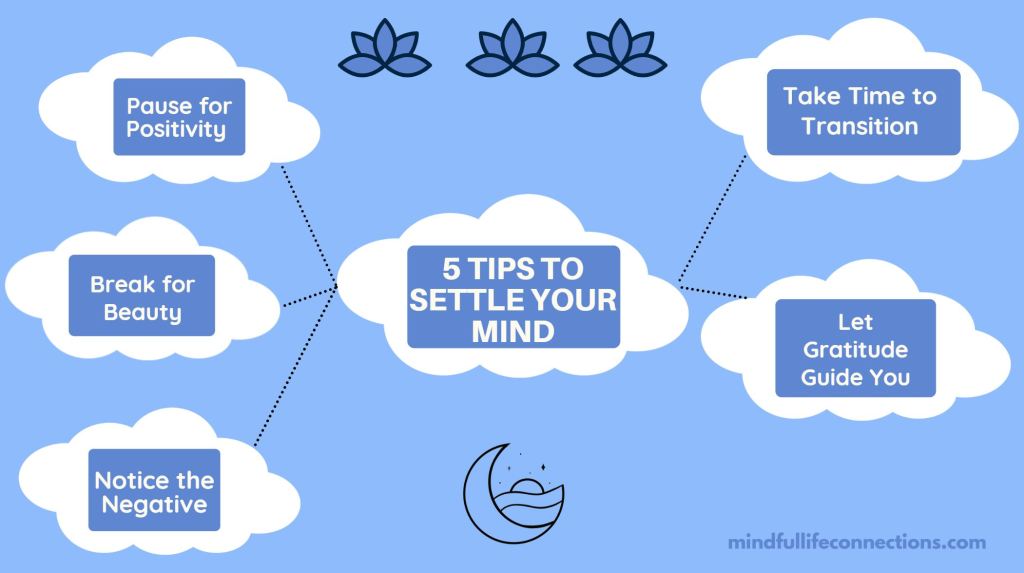
5 Tips for Minds like Mine
Pause for Positivity
Pause – receive the compliment, hear kind words, observe the good in humanity, see the beauty, feel the love – pause – soak it in – stay with it – where do you feel it? Build your neural pathways and capacity for positive emotions.
Break for Beauty
The way the clouds look in the sky, the brilliant color blue of the water, the flower growing in the parking lot. Noticing, looking, and taking in the beauty around me has helped me have a more grateful heart and enjoy life. Even when the day has been long or I’ve just received bad news, I can look to what pleases my eyes and know that joy exists in the world.
Notice the Negative
I am not my thoughts. This helps especially when I am feeling angry, pessimistic, judgmental, frustrated, overwhelmed – or all of these and more. I can be aware of my emotions and not be pulled by them. The thoughts and emotions will pass, my head will clear, and I can choose to move forward with positivity and compassion.
Let Gratitude Guide You
When you think of something you are grateful for – savor it – express it. Let people around you know and feel your gratitude. Look to feel the positivity, celebrate the success, and build the good feeling connections in the brain
Take Time to Transition
Honor beginning and endings. Pause at the threshold, the morning, the evening, the new year, the new life, the passing. Take a moment to be grateful and set an intention for what is next.
The benefits of meditation are substantial and well-known, which is why many of us are striving to integrate the practice into our daily lives. My best friend and now business partner, Renee, and I set out on our learning-to-meditate-journey together. That shared resolution, made while on vacation, is one we’ve kept over the years because meditation has improved so many aspects of our individual and collective lives.
Our advice to new meditators is to be curious and kind to yourself while you explore a variety of meditation approaches with the goal of finding what resonates and what doesn’t. Recognizing it takes years of practice to become an experienced meditator, we didn’t pressure ourselves–or strive–but simply eased into it at first and then continued practicing, studying, changing.
So smile, stay present, and your meditation practice will emerge as you learn and grow. Here are 5 tips to help you do just that.
#1: Just Get Started and Do Something or Nothing
Picture the two of us on January 1st, standing in knee-deep water, our breath following the breeze, turning our heads into the wind to inhale love and turning them away to exhale judgment, inhaling joy and exhaling criticism, inhaling peace and exhaling stress, inhaling satisfaction and exhaling perfectionism.
When we first started our meditation practices, we really didn’t know what we were doing, but we did it anyway. If you’re not sure what to do, know that it’s perfectly okay just to sit (or lie) and do nothing. The time spent in silence will still provide benefits and help build your practice.
#2: Release Pressure and Expectation
Although we certainly can sit in a lotus position if we’d like, the truth is, no special position or equipment is required to become an effective meditator. It’s not necessary to have a cushion or bench or to hold our hands in a certain kind of way. It’s perfectly fine to lie in our beds or on our couches, to walk, or to sit at our kitchen tables or on a bench outside.
It’s important to go into meditation knowing that we really can’t clear our minds or stop the 40,000+ thoughts that go through it each day, so there’s no point in trying. We can simply watch thoughts arise and fall, coming and going like clouds in the sky. We can do our best to follow the breath, but, if that doesn’t work, sounds or other sensations we’re experiencing can also serve to anchor our practice.
#3: Take Free Classesand Try Free Podcastsor Apps
Many schools, workplaces, and community centers offer low- or no-cost meditation classes while many churches, colleges, and retreat centers offer labyrinths to use for walking meditation practices. The Worldwide Labyrinth Locator can help find one near you.
Coursera, Udemy, Mindful Schools, Class Central, and many other websites offer free meditation courses. At the beginning of our meditation journey, we benefitted from Jack Kornfield and Tara Brach’s free, 40-day online mindfulness meditation course and would strongly recommend it.
Online meditation videos abound as do countless free apps to help us develop, deepen, and sustain an effective meditation practice. Some of our favorites are Daily Breath by Deepak Chopra, Calm, Headspace, Plum Village, and Insight Timer.
#4: Try Different Types
As we expanded our practice, we learned more and more about the different types and styles of meditation, and we continue learning and growing, understanding that practice, not perfection, is our goal.
On that first day at the beach, we didn’t know we were actually doing a kind of practice known as Tonglen. Experienced Tonglen practitioners take in some of the suffering of the world, transmute it in their hearts, and breathe it back out in the form of healing thoughts and feelings for their fellow human beings. Even if we’re not there yet, we too can aspire to breathe in injustice and breathe out peace, breathe in judgment and breathe out acceptance, breathe in anger and breathe out love.
Sometimes we’ll simply sit in silence for meditation practice, and other times we’ll seek out the guidance of another teacher. Some of these guided meditations are specifically designed to help us deal with difficult feelings, such as acceptance, anger, anxiety, depression, fear, and letting go, while others help us develop and expand positive emotions such as connection, gratitude, flow, or patience.
There are countless meditation approaches to try: walking or movement, mindfulness, Loving-Kindness or Metta, mantras, Gathas, body scans, chanting, contemplation, healing, and many, many more. Try as many as possible, as it’s not necessary to lock into one style or type, especially as we’re learning and developing a practice that is meaningful to each individual.
#5: Value Consistency Over Quality
This final tip is the most important: Just show up. Do something, anything every single day, and before you know it, a regular meditation practice will emerge.
At first, our goal was to simply strive for five minutes a day. Those five minutes a day spent meditating in the water all those years ago have morphed into meaningful morning practices to set our daily intentions, Sharon Salzberg’s stealth meditations to maintain perspective at work, and important evening practices to help us reflect, accept, and appreciate the complexities that come with this human experience.
We hope these tips will help you develop and maintain a meditation practice that works for you. Feel free to leave us a comment about where you are in your meditation journey or which tip resonated most with you.







 Mindful Life Connections